


2026 is the year Brazil rewrote the tax rules foreign investors had relied on for three decades. Tax-free dividends are gone, and a new VAT-style consumption tax is being phased in alongside the old one.
Brazil remains Latin America's largest economy and one of the markets our clients ask about most. That is why ACE opened its São Paulo office in Alphaville-Barueri this year. Here is what any company planning to enter Brazil, or already operating there, needs to know now.
Corporate income tax: 34% combined
Brazilian companies pay two taxes on profit, which together reach 34% for most businesses.
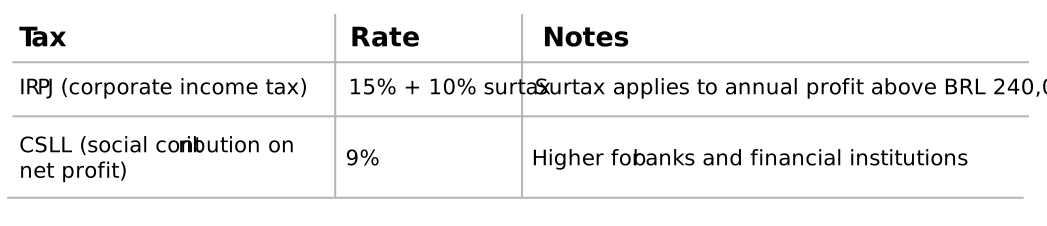
Companies choose between three regimes, and the choice matters:
- Lucro Real (actual profit): tax on real accounting profit. Mandatory for large companies and some sectors.
- Lucro Presumido (presumed profit): profit is deemed to be a fixed share of revenue. Available up to roughly BRL 78 million in annual revenue, and often simpler for service businesses with healthy margins.
- Simples Nacional: a simplified small-business regime, generally not available to companies with foreign shareholders.
Picking the right regime at setup can change the effective tax burden significantly, so it should be modelled before the entity is registered.
Dividends: the end of tax-free repatriation
Since 1 January 2026, dividends paid by Brazilian companies to foreign shareholders carry a 10% withholding tax, under Law 15.270/2025. For nearly 30 years, Brazil was one of very few countries that did not tax dividends, so this is a fundamental change for foreign-owned subsidiaries.
The key points:
- Who pays: the 10% applies to dividends paid, credited or remitted to non-resident individuals and companies alike, including those in low-tax jurisdictions.
- Exemptions: foreign governments (on a reciprocal basis), sovereign wealth funds and foreign pension funds.
- 34% cap: the combined effective corporate tax and dividend tax cannot exceed 34%. Where the company's effective rate is already high, part of the 10% can be credited back.
- Tax treaties: Brazil's double tax treaties may reduce the withholding or allow a credit in the shareholder's home country, depending on the treaty and the parent company's position.
- Residents too: Brazilian-resident individuals now pay 10% on dividends above BRL 50,000 per month from a single company.
The old playbook of simply repatriating profits as dividends no longer works by default. Dividend timing, treaty positions and alternatives such as interest on equity (JCP) now need deliberate planning.
Consumption tax reform: a dual VAT, phased in to 2033
Brazil is replacing its main consumption taxes with a dual VAT, similar in design to the European model. The federal CBS replaces PIS and Cofins, and the state and municipal IBS replaces ICMS and ISS. A separate Selective Tax (Imposto Seletivo) will apply to goods such as tobacco and alcohol.
The new system brings full input-tax credits, taxation at destination, and split payment: banks and payment providers separate the tax at the moment of payment and pass it straight to the authorities.
Brazil runs old and new consumption taxes side by side until 2033

The long transition is where the real work lies. Until 2033, companies must comply with both systems at once, and split payment will change cash flow, since sellers receive only the net amount. The old ICMS rules, which differ across Brazil's 27 states, were among the hardest parts of doing business there; the reform should simplify that over time.
What to do now
Whether you are planning to enter Brazil or already operate there, four steps are worth taking before year-end:
- Review your dividend policy. Model the 10% withholding against your group's cash needs, and check which treaty applies to your parent company.
- Re-check your tax regime. The choice between Lucro Real and Lucro Presumido can shift under the new rules, especially for profitable service businesses.
- Get invoicing ready. Make sure your ERP and e-invoicing setup handles the CBS and IBS fields, and plan for split payment in 2027.
- Plan for two systems. Until 2033, budgets, pricing and contracts need to work under both the old and the new consumption taxes.
How ACE can help
ACE's São Paulo office supports companies through every stage of entering Brazil: market discovery, entity setup, accounting, payroll and tax compliance. Our local team handles the local detail so you can focus on growing the business.
----------------------------------------------
 Get in Touch
To discuss your Brazil plans, contact our Brazil country lead, Dirk Blom, at dirk.blom@expandwithace.com, or get started here.
This article is for general information only and does not constitute tax advice. Rules and rates may change; please seek advice for your specific situation.
Sources
- Brazil Counsel: Brazil Reintroduces a 10% Tax on Dividends
- Souto Correa: Law No. 15,270/2025 Published
- Baker McKenzie: Law 15,270/2025 enacted
- EY: Guidance on new withholding tax on dividends
- HCO: Split payment and the reform timeline
- VATCalc: Brazil tax reform 2026 to 2032

The Journey
Global expansion requires structure, clarity, and the right local support. ACE leads you through a FOUR-PHASE JOURNEY that starts with understanding the market landscape, continues with securing early traction, and supports you in building the right team. We then ensure your company is properly established and compliant in its new location. This framework gives your business everything it needs to expand with confidence.
Pick what you need
The services can also be offered individually, providing flexibility to meet the specific needs of your business.
Speak with our experts.
Complete the form and our team will contact you to discuss your international growth plans.

